
97% of your audience isn’t ready to buy yet. So why are you marketing like they are?
That is the part many small businesses miss.
When someone comes across your business, they are not all in the same place. Some are just starting to notice a problem. Some are looking for answers. Some are comparing options. A small group is ready to act now.
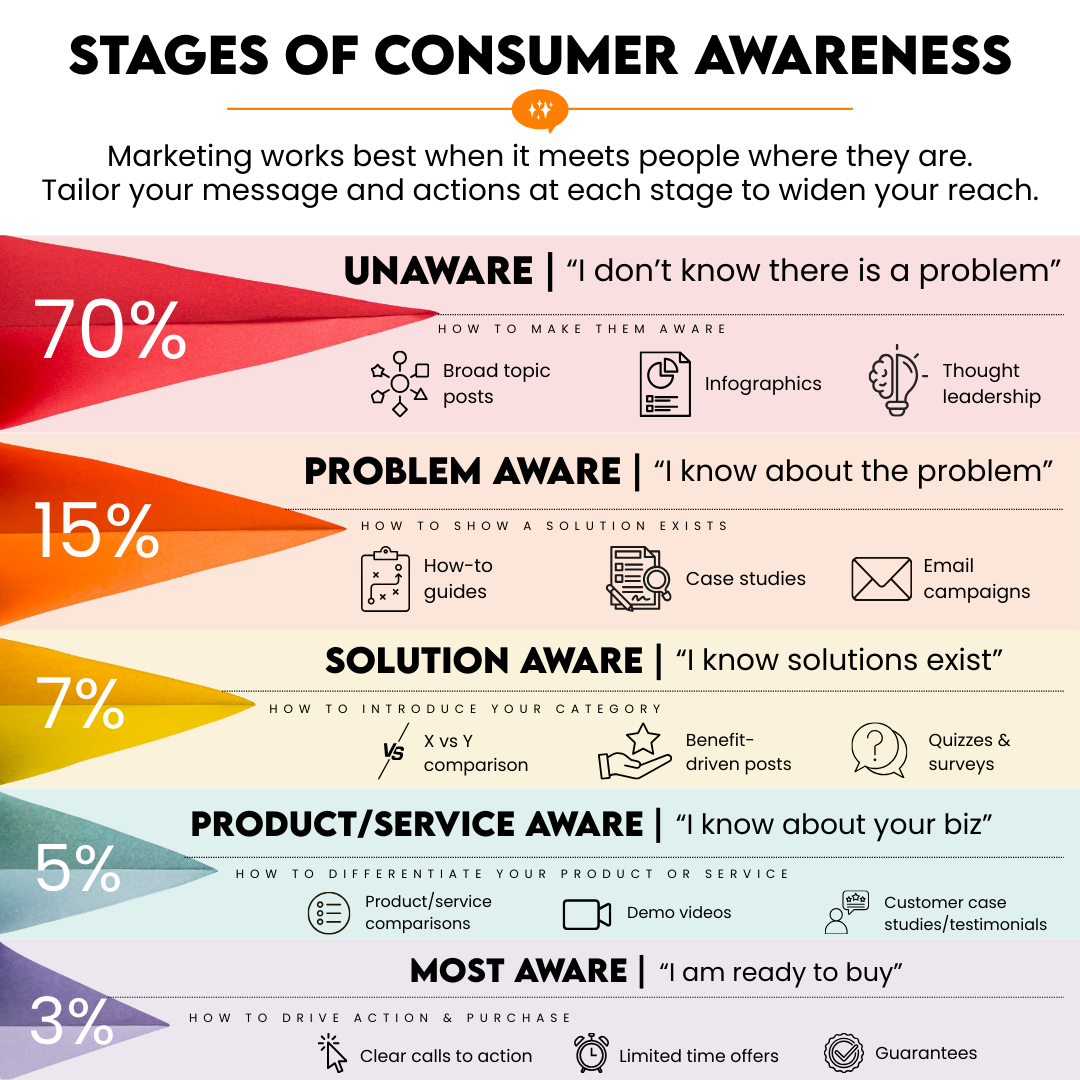
You post the offer. Share the service. Mention the product. Add the call to action. And then wonder why people are seeing it but not doing much with it.
Usually, it is not because your business is the problem. It is because your message is aimed at the wrong moment. Most people are not there yet.
If you want your content to work harder, it has to match where people actually are. That is what the stages of consumer awareness help you do.
What the stages of consumer awareness actually mean
This framework is simple: people need different messages at different points in the buying process.
That means not every post should sell the same way.
Not every email should push for the same action.
And not every visitor to your website is ready for the same next step.
Some people need the problem named. Some need help understanding their options. Some need proof that your business is the right fit. And, some just need a clear reason to stop waiting.
When you understand that, your marketing starts to feel a lot less random.
1. Unaware
They do not know there is a problem yet.
At this stage, the person is not looking for your business because they do not fully realize they need what you offer.
They are dealing with something inconvenient, inefficient, outdated, or frustrating — but they may not have put real language around it yet.
Your job here is not to sell. Your job is to make the problem click.
For your business, that might look like:
a post that points out a common mistake
a quick tip that makes someone think, “Wait, that is me”
a stat or visual that reframes something familiar
a broad educational post that gets people to see the issue differently
This is top-of-funnel content, yes. But more importantly, it is the kind of content that earns attention before someone is actively looking.
2. Problem Aware
They know something is wrong.
Now they feel the issue. They know the frustration is real. They may even be searching for advice, asking friends, reading reviews, or trying to figure out what to do next.
Your job here is to show that help exists.
This is where useful, clear content matters most. You are not trying to overwhelm them with your offer. You are trying to help them understand the problem and feel less stuck.
For your business, this might look like:
a how-to blog post
an explainer video
an FAQ post
a case study that mirrors their situation
an email that breaks down what is actually going wrong
This is often where trust starts. Not because you pushed harder, but because you made things easier to understand.
3. Solution Aware
They know there are ways to fix it.
At this point, the person knows they need some kind of solution. Now they are sorting through the possibilities.
They may not know your business well yet, but they are learning the landscape. They are comparing categories, approaches, price points, or ways of solving the problem.
Your job here is to help them understand their options — and start seeing why your type of solution makes sense.
For your business, that might look like:
an “X vs. Y” post
a comparison guide
a quiz that helps someone narrow down what they need
a blog post explaining the pros and cons of different approaches
a post focused on outcomes, not just features
This stage matters because people are building their decision criteria here. If you can help shape how they think, you are already doing important marketing work long before they reach out.
4. Product or Service Aware
They know about your business.
Now you are in the running.
They know your name. They have likely seen your website, social posts, reviews, or offer. They are comparing you to other options and trying to decide whether your business feels like the right fit.
Your job here is to reduce doubt and build confidence.
This is where people need proof. Clear proof. Not vague claims. Not generic “we care” language. Actual reasons to believe that working with you will go well.
For your business, that might look like:
testimonials that sound like real customer concerns
before-and-after examples
demo videos or walkthroughs
case studies
side-by-side comparisons
a website that clearly explains what you do, who it is for, and what happens next
If someone already knows about your business, this is not the moment for fuzzy messaging. It is the moment for clarity.
5. Most Aware
They are close to buying.
This is the smallest group, and the one most businesses obsess over.
These people know what they need. They know about your business. They may already want to work with you. What they need now is not more explanation. They need a clear, easy next step.
Your job here is to make action feel simple.
For your business, that might look like:
a strong call to action
a limited-time offer
a clear booking link
a shorter contact form
a guarantee that reduces hesitation
a follow-up email that nudges them back in
This is where conversion happens. But it works best when the earlier stages have already done their job.
Why this matters for small businesses
A lot of small business marketing gets stuck here: talking only to the people who are ready right now.
That usually sounds like:
buy now
book now
contact us today
schedule your consultation
don’t miss out
There is nothing wrong with those messages. You need them.
But if that is all your marketing does, you are speaking to the smallest slice of your audience and skipping over everyone else who could become a customer with the right message first.
That is the bigger opportunity.
Some people need education before they need your offer.
Some need reassurance before they need urgency.
Some need to understand the problem before they are willing to solve it.
When your content reflects that, your marketing starts to feel more balanced, more useful, and a whole lot less forced.
What this looks like in real life
Let’s say you run a local service business.
One post helps people notice a problem they have been ignoring.
One explains why it is happening.
One compares the common ways to fix it.
One shows how your process works.
One makes it easy to request a quote.
That is a much smarter content mix than writing five versions of “Call us today.”
The same idea works whether you sell products, offer services, run events, manage a nonprofit, or work in healthcare, hospitality, retail, real estate, or home services.
Not every post needs to close the sale.
Some posts need to earn the right to ask.
A simple way to use this in your own marketing
Before you write your next post, email, ad, or web page, ask yourself:
What stage is this for?
That question alone can clean up a lot of weak marketing.
Because when you know the job of the content, the message usually gets clearer too.
A simple content mix might include:
one piece that sparks recognition
one that explains the problem
one that helps compare options
one that proves your value
one that asks for action
That is how you build marketing that speaks to more than just the people who were already ready.
FINAL THOUGHT
If your marketing has been feeling repetitive, overly promotional, or harder than it should, this may be the reset you need.
You do not need every piece of content to close the sale. You need it to move the right person one step closer.
That is a much more useful goal. And usually, a much more effective one too.
Take a look at your last five posts, emails, or campaigns and see which stage each one was really speaking to. If most of them were aimed at the final decision, there is a good chance you have room to reach a much bigger audience by backing up and building trust earlier.
Inspired by coverage from @overnightstrategist, with visuals reworked in-house.